
Physics Chapter 02 : Lecture
Lecture
Notes
Some Important Questions
CHAPTER
2
Motion in a Straight Line
“Facts are not science — as the dictionary is not literature.”
Martin H. Fischer
# Rest and Motion



Rest
If the position of an object does not change w.r.t. its surrounding with the passage of time, it is said to be at rest. e.g.
Book lying on the table, a person sitting on a chair, etc.
Your content goes here.
Motion
If the position of an object is continuously changing w.r.t. its surrounding w.r.t time, then it is said to be in the state of motion. e.g. The crawling insects, water flowing down a dam, etc.
Your content goes here.
# Types of Motion
On the basis of the nature of path followed, motion is classified as :
Rectilinear Motion :
The motion in which a particle moves along a straight line is called rectilinear motion.
e.g. motion of a sliding body on an inclined plane, a car moving on a straight road.

Circular Motion :
The motion in which a particle moves in a circular path is called circular motion.
e.g. A string whirled in a circular loop.

Oscillatory Motion :
The motion in which a particle moves to and fro about a given point is
known as oscillatory motion. e.g. Simple pendulum.

# How to plot a position time graph?
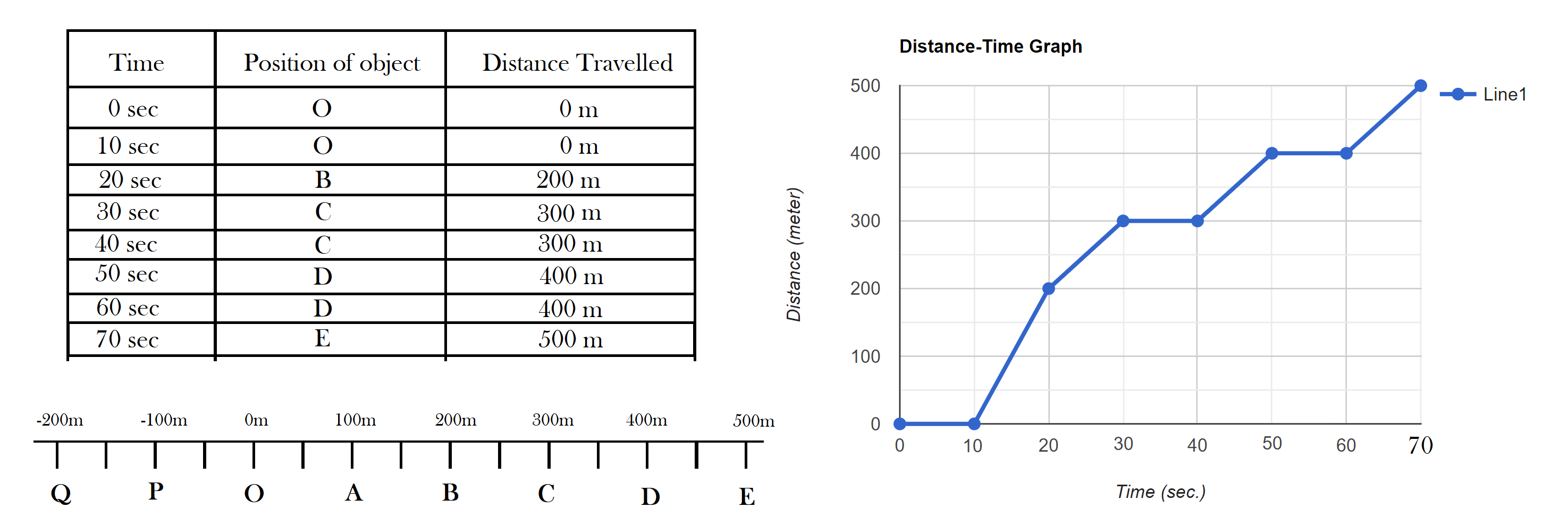
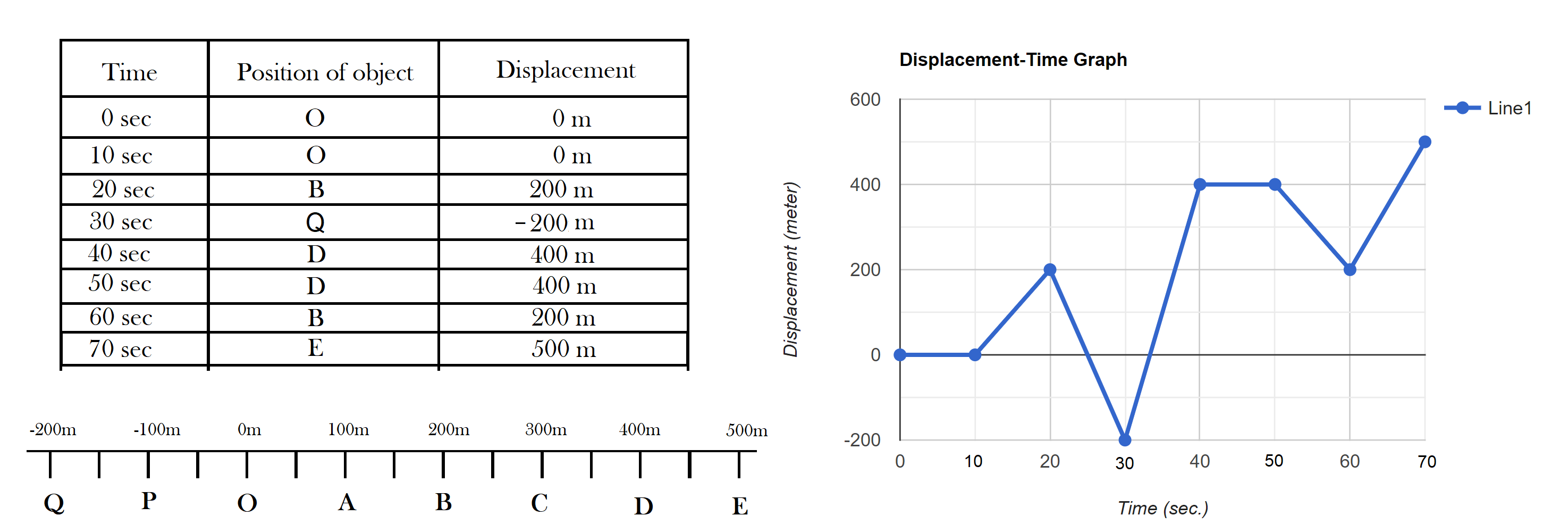
Changes Around Us
Physical Change
Those changes which are accompanied with change in physical properties of the substances but no new substance is formed are called physical changes
- e.g., melting of ice, boiling of water, etc.
Chemical Change
- e.g., burning of candle, cooking food, etc.
Centre of Curvature : The centre of the spherical shell, of which the mirror is a part, is known as the centre of curvature of the mirror. It lies outside the surface of the mirror. Every point on the mirror surface lies at the same distance from it. Here, C is the centre of curvature of the mirror.
Concave mirrors are commonly used in torches, search-lights and vehicle headlights to get powerful parallel beams of light.
(non-reflecting) material.
What effect will this have on the image of an object placed in front of
the mirror?” stroke_width=”0″ _builder_version=”4.21.0″ _module_preset=”default” global_body_text_color=”#FFFFFF” main_body_text_color=”#FFC500″ main_body_font_size=”25px” custom_margin=”||20px||false|false” custom_padding=”||||false|false” global_colors_info=”{}”][/dipl_text_highlighter]
If a part of mirror is covered with an opaque object then intensity of the image formed will decrease as the image will be formed by less no. of light rays, therefore image will be dull.